CLASSIC BEAUTY
Recently landed: Classic Beauty
Gracia’s written response to The Stuttgart Ballet’s The Sleeping Beauty, especially for Fjord Review.
Subscribe to and support Fjord Review.
The curtain rises on a fairy-tale and the theatre around me all but disappears. There is the sensation that I am turning the pages of Charles Perrault’s 1697 telling of Sleeping Beauty. That the clock has been rewound. That I am within a castle’s courtyard, surrounded by a succession of contiguous white arches set against viridescent and ordered vegetation. The palette is plucked from the Baroque because I am now, like the characters, in the Baroque period. It is fantasy, beauty, and embellishment, but with a distinct made of paper feel. The sky overhead, a perfect shade of blue on the page. And the costuming of those gathered reflects a blue-sky day. The royal attendants of the Stuttgart Ballet are wearing satin gowns and fitted jackets as if fashioned by the gentle air currents, and their white wigs, a cumulus upon their heads. Marcia Haydée’s The Sleeping Beauty, presented by the Australian Ballet, at the Regent Theatre, Melbourne, is a magical fable. It has been some fifty years since the invited company, the Stuttgart Ballet, were last here and the effect is entrancing. Unlike Carabosse, my invitation was received, and the opportunity to lose myself in the classic is one I heartily accept.
With choreography by none other than Princess Aurora herself, Haydée, after Marius Petipa, and refined and masterful stage and costume design by Jürgen Rose, this Sleeping Beauty is generous with its double tours and high assemblés. It is bright, and light on mime. Dance is given space to breathe. It is a celebration of subtle tonal gradations. In the folds of a paper theatre, green is never merely green, but a recognition of a yellow or blue undertone, and it is accented by peach and mulberry or lavender and ice. As one by one the fairies appear to bestow their various gifts upon Aurora, the effect is one of a hand-coloured lithograph coming to life. From soloist Mizuko Amemiya’s the Fairy of the Crystal Fountain to demi soloist Aoi Sawano’s the Fairy of the Golden Vine, delicate colour transitions add to how I read the variations. As Amemiya repeatedly changes her balance, but never cracks, Sawano’s arm movements bristle with electricity.
●
22nd of October, 2026
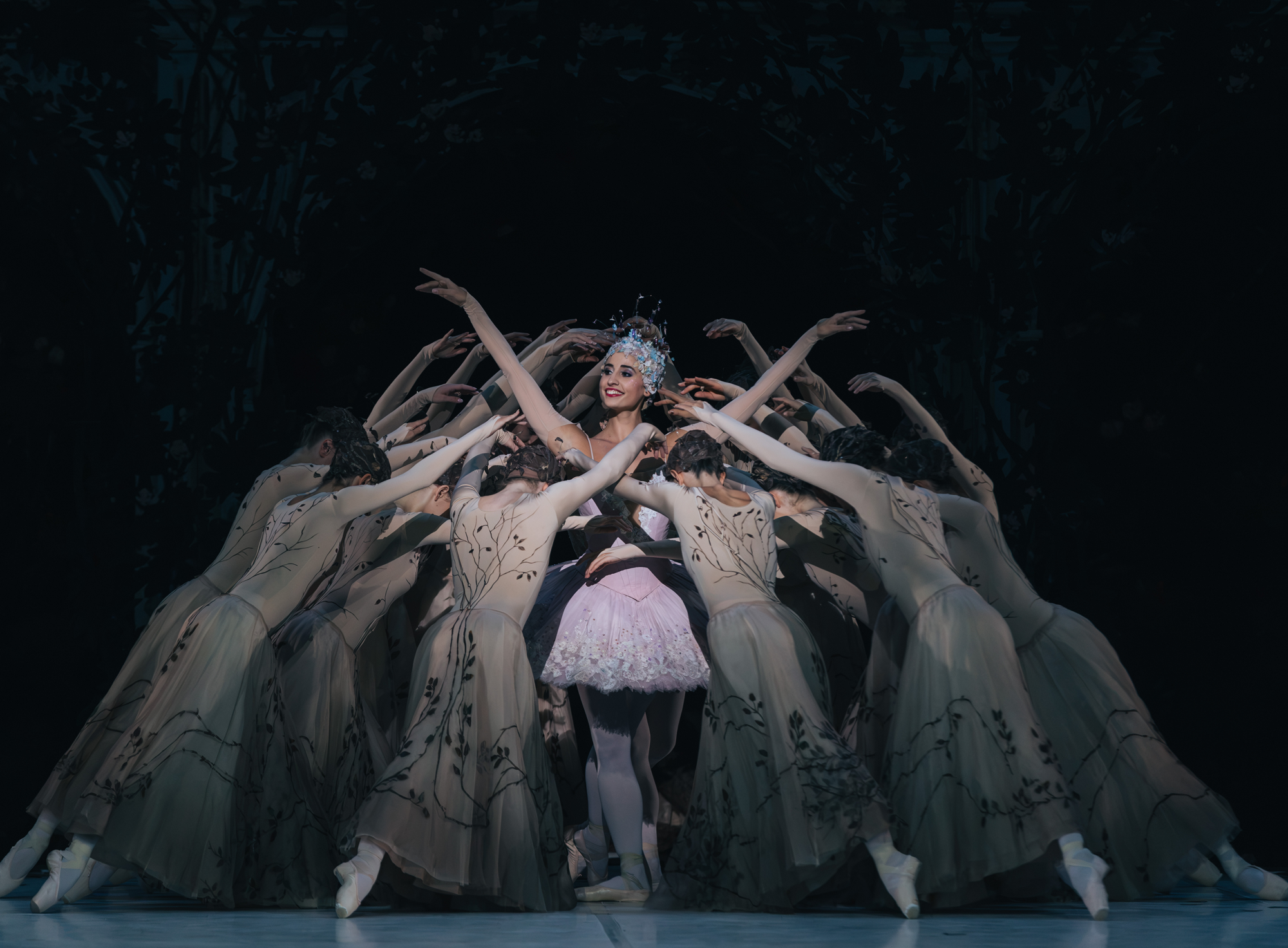
Alicia Torronteras and Artists of The Stuttgart Ballet in The Sleeping Beauty by Marcia Haydée (image credit: Kate Longley)
