RESTORING CORRIDORS, TAKEN UP AGAIN
As night gathers, one by one they will be able to make their way back to the wild. Their absence from the enclosure, in the weeks that follow, will signal their successful absorption back into the safe, free fold of the leaves; the soft and nimble embodiment of ‘wilderness’, slowly, knowing growing, their way home.
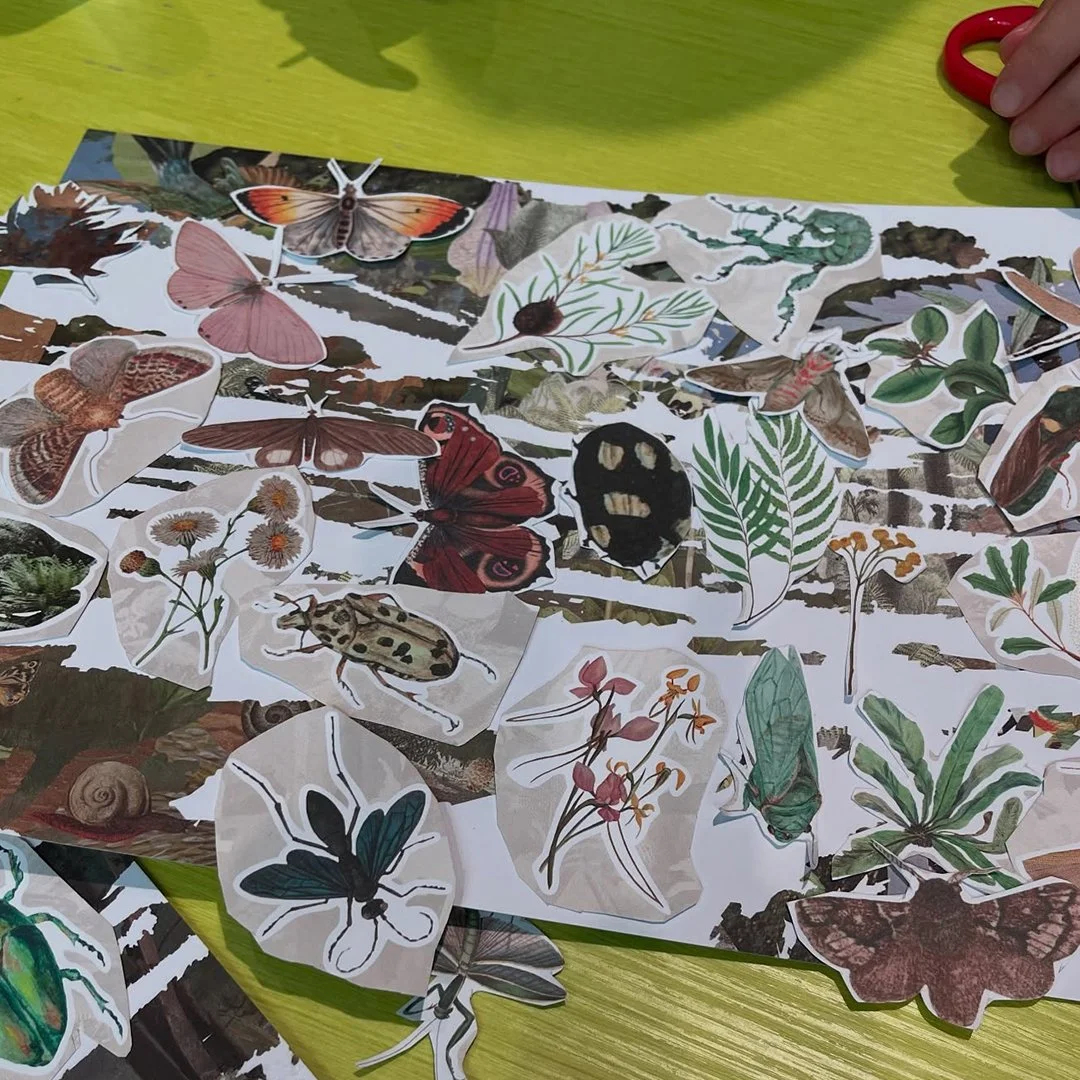
Restoring Corridors Collage Workshop with Gracia and Louise


Gracia Haby & Louise Jennison
Restoring corridors, taken up again
2025
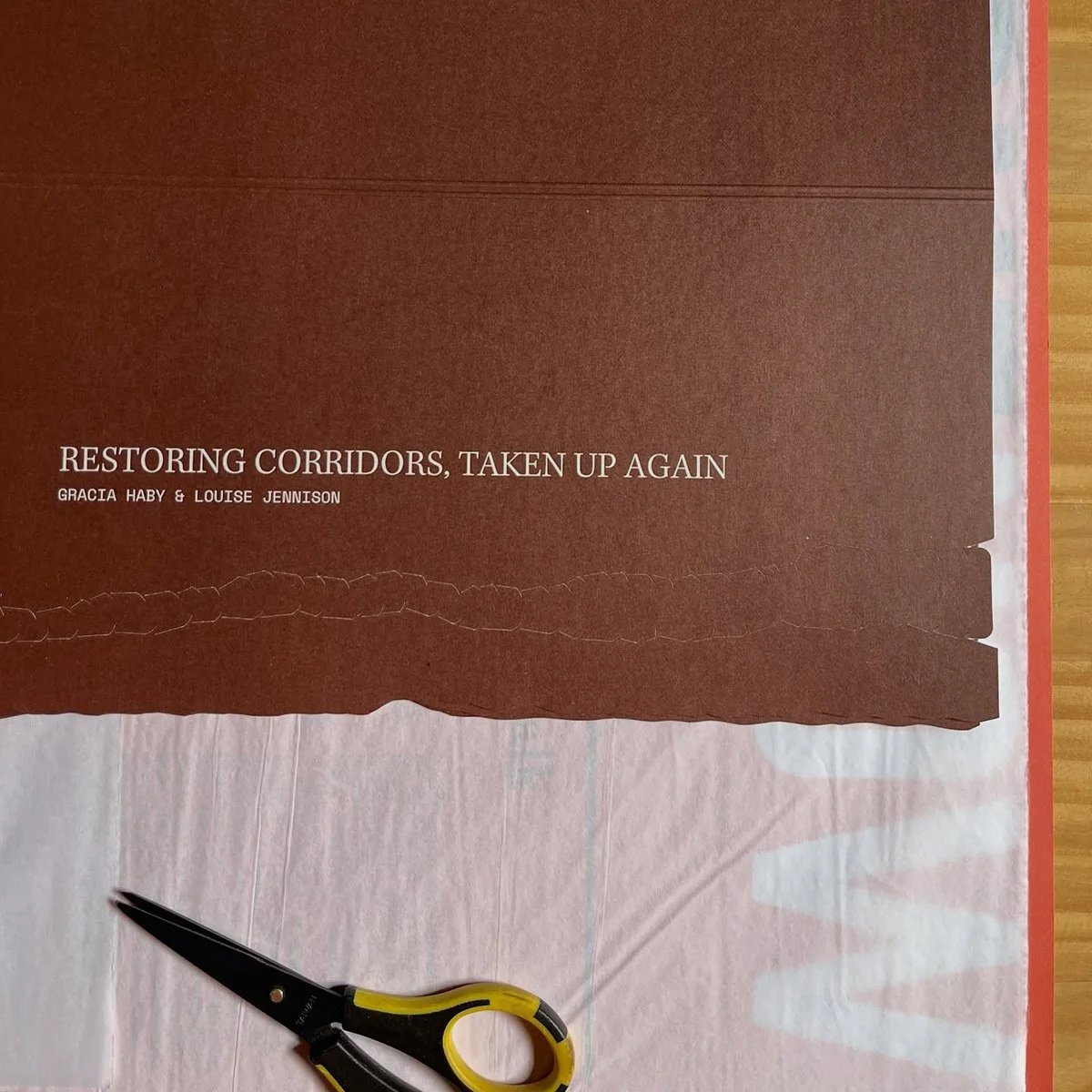
12 page, nine-hole pamphlet stitched, artists’ book with fold-out colour image insert, with A good soft release site is a connected site (by Gracia Haby), Indigo Digital CMYK on 150gsm Envirocare + 200gsm Ecostar Silk, with cover, Indigo Digital CMYK on 300gsm Envirocare
Printed by Bambra
Bound by Gracia Haby & Louise Jennison, with hand-cut elements
Edition of 100
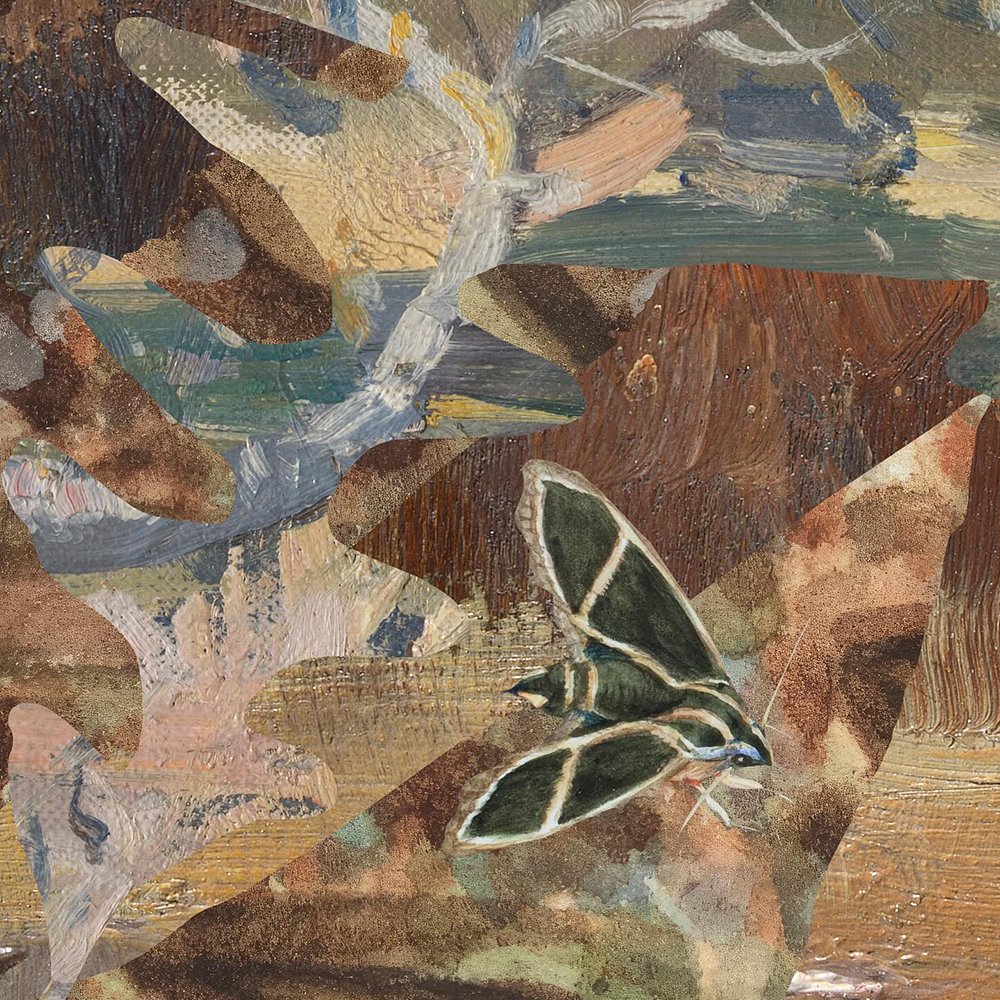
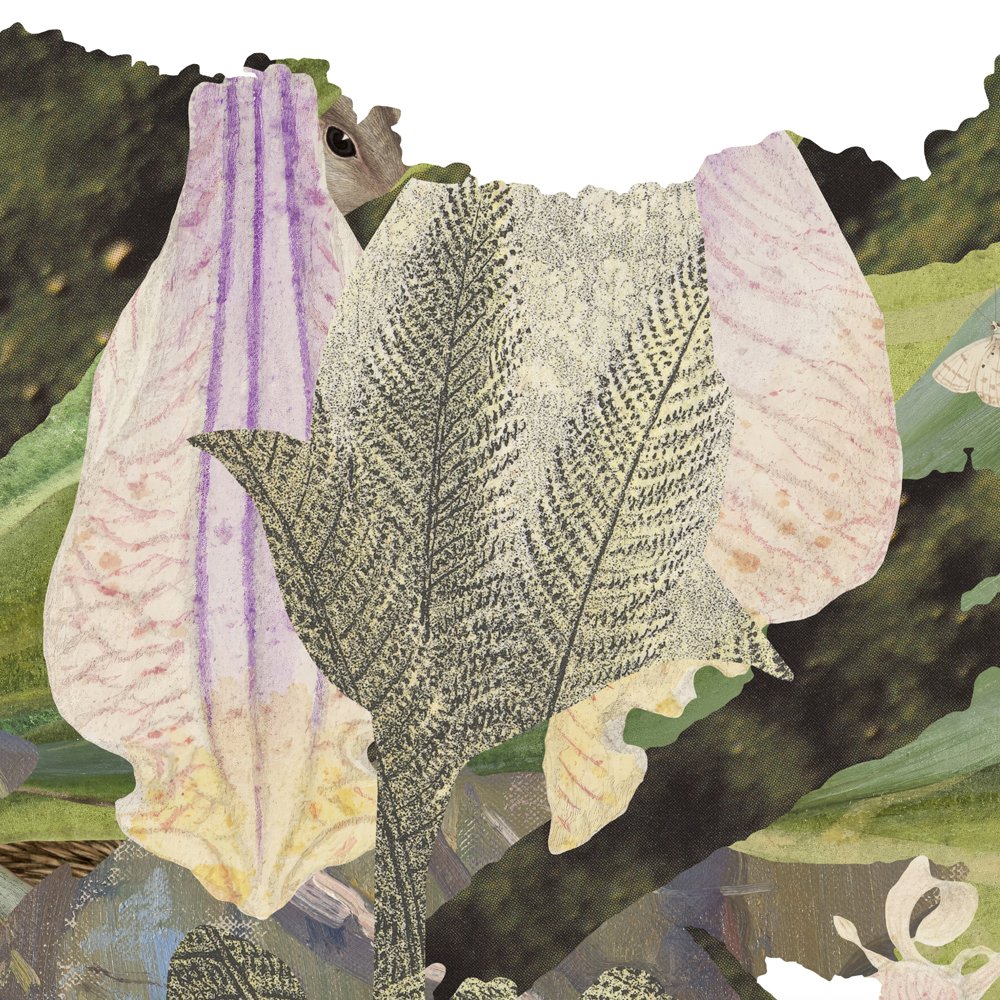
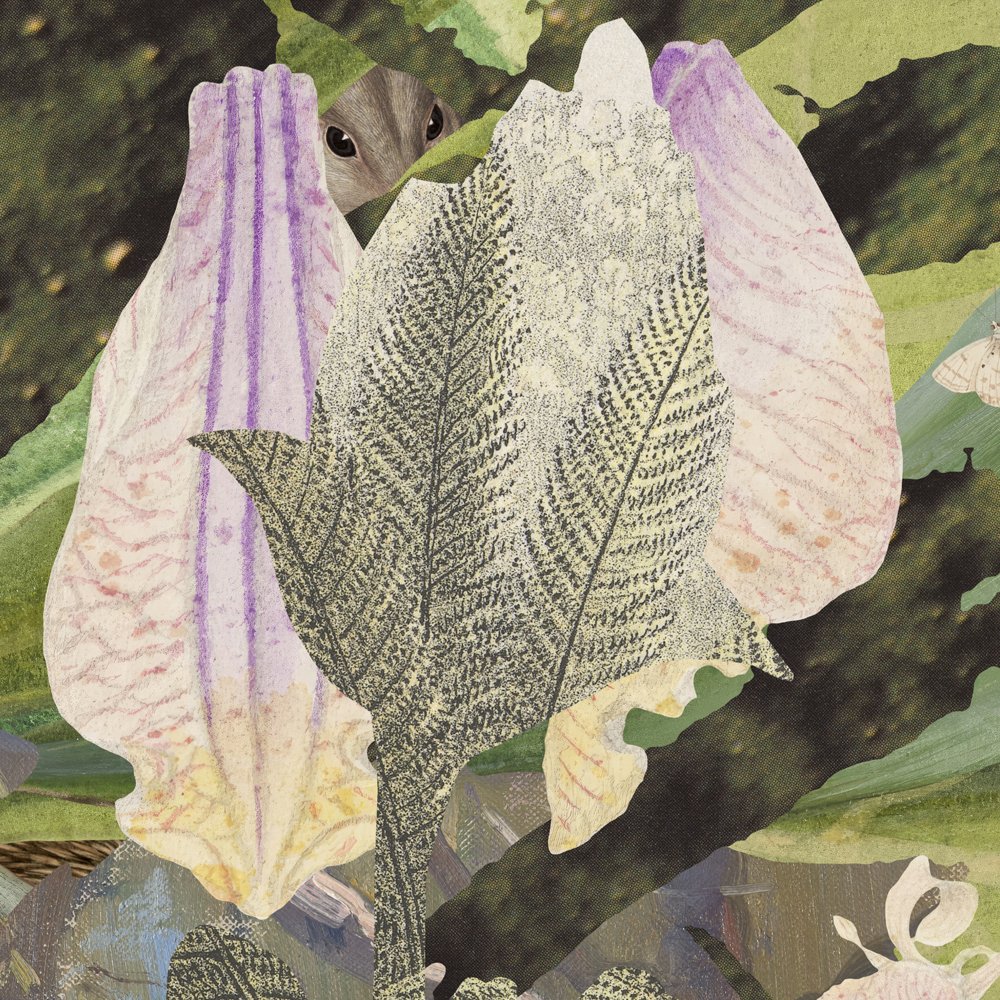
Springing from Restoring corridors of 2024, a multi-panelled, double-sided artists’ book that forms an interchangeable, reversible 100cm x 300cm slice of biodiversity in flux, when hung on the wall, comes the (closer to) pocket-sized version, Restoring corridors, taken up again. Where the former was housed within an original hand-painted watercolour box, the latter comes folded and zipped.
Restoring corridors, taken up again was launched from our stall at the eleventh Melbourne Art Book Fair, NGV International (Friday 16th of May – Sunday 18th of May, 2025). We also read it aloud, as part of our Kids Pumpkin Storytime session, presented by NGV, on Saturday 17th of May, beneath Kusama’s Dancing Pumpkin.
Editions of Restoring corridors, taken up again have been acquired by State Library Victoria, and the Research Library and Archive of the Art Gallery of NSW.
You can order a copy through our online store, and read but a taste below, or in full on Marginalia.
●
…
Of entering another kind of space, I am reminded of Annie Dillard’s individual connection with a weasel “who was looking up at [her]” as he emerged from “beneath an enormous shaggy wild rose bush”, in ‘Living Like Weasels’ from Dillard’s essay collection Teaching a Stone to Talk (1982)[iv]. “He was ten inches long, thin as a curve, a muscled ribbon, brown as fruitwood, soft-furred, alert.” They locked eyes, and it felt as though “someone threw away the key.” Held, in that connection, it “moved the fields, and drained the pond; the world dismantled and tumbled into that black hole of eyes.” Later, Dillard describes the impression left when the weasel disappeared as “already I don’t remember what shattered the enchantment. I think I blinked, I think I retrieved my brain from the weasel’s brain, and tried to memorise what I was seeing, and the weasel felt the yank of separation”. In that encounter, where something new emerged, a new space, a new kind of knowing, they had both “plugged into another tape simultaneously, for a sweet and shocking time.” Right there on the page, Dillard left the space she’d known, and was guided by a different kind of knowing[v].
Equally, when Kathleen Jamie notes an extraordinary silence that radiates from the mountains and the sky, from “a mineral silence, which presses powerfully upon our bodies, coming from very far off”[vi] (in Sightlines, 2012), this is not unlike how it feels to be in the presence of a wild animal, to look into their eyes, to feel as though you are held in a radiant connection. That for one moment, you see the smallest of fragments of what they see. And you feel you are a million miles from ever being able to understand what they see, know, feel, are, but you have this one precious taste. An opening into the extraordinary before it is quickly whisked away in Dillard’s blink of an eye.
What does the world look like up there from the tree canopy or flying overhead? I could climb a tree and I would still not know what a possum knows[vii]. I can see the world from an aerial drone, but I can’t read the landmarks like a Grey-headed flying fox (Pteropus poliocephalus)[viii]. It is more than dotted coordinates, their ‘worldscape’. Their map, I surmise, has a feel to it that I’ll never know. In this gateway to awe, coupled with the recognition of what they can teach us, me, there is a rekindling of hope, on a tangible level.
…
[iv] Annie Dillard, ‘Living Like Weasels’, Teaching a Stone to Talk (Edinburgh: Canongate, 1982), pp. 66–67.
[v] Amina Cain, A Horse at Night: On Writing (London: Daunt Books, 2022), p. 118
[vi] Kathleen Jamie quoted by Ewa Chodnikiewics in ‘Keep Looking, Even When There’s Nothing Much to See: Re-imagining Scottish Landscapes in Kathleen Jamie’s Non-fiction’, The Poetics of Space and Place in Scottish Literature, ed. by Monika Szuba and Julian Wolfreys, (Cham, Switzerland: Palgrave Macmillan, 2019), p. 94.
﹏
RELATED LINKS,
RESTORING CORRIDORS, 2024
NGV MELBOURNE ART BOOK FAIR 2025
RESTORING CORRIDORS COLLAGE WORKSHOP
CASTLEMAINE PRESS ARTISTS’ TALK
RELATED POSTS,
“PRACTICE ANY ART… TO MAKE THE SOUL GROW”
A COUPLE OF QUESTIONS
SANCTUARY
BRILLIANTLY FAIR
DONE AND DUSTED, CUT AND GLUED
LOOK CLOSER
NOW AND WINGED
BEHIND THE SCENES
MORE THAN FAIR, FOR SURE
STAGE SET
PIECE BY LEAF
CONNECTING THREADS
BILL & JEAN
OTI, TOFFEE, & MARBLE
ROSE, CONSTANCE, & HARRY
MANY EYES
WILD TAILS

Gracia Haby & Louise Jennison
Restoring corridors, taken up again
12 page, nine-hole pamphlet stitched, artists’ book with fold-out colour image insert, with A good soft release site is a connected site (by Gracia Haby), Indigo Digital CMYK on 150gsm Envirocare + 200gsm Ecostar Silk, with cover, Indigo Digital CMYK on 300gsm Envirocare.
Printed by Bambra
Bound by Gracia Haby & Louise Jennison, with hand-cut elements
Edition of 100
Restoring corridors, taken up again was launched from our stall at the eleventh Melbourne Art Book Fair.










Additional References
Aalto, Kathryn, Writing Wild: Women Poets, Ramblers, and Mavericks Who Shape How We See the Natural World (Portland: Timber Press, 2020)
Bailly, Jean-Christophe, The animal side, trans. by C. Porter (New York: Fordham University Press, 2011)
Baker, Henry, Paper, ‘Of certain undescribed worms’, 2nd April, 1761, The Royal Society, https://makingscience.royalsociety.org/items/l-and-p_4_64
Berger, John, ‘Why Look at Animals?’, About looking (London: Bloomsbury, 1980), pp. 1–26
Boyer, Annabel, ‘The World we Make: A Musing on Place and Belonging’, Wonderground, 14th July, 2022, https://wonderground.press/culture/the-world-we-make-place-and-belonging
Carson, Rachel, Silent Spring (London: Penguin Books, 2000)
Cramer, Viki, The Memory of Trees: The future of eucalypts and our home among them (Port Melbourne: Thames & Hudson Australia, 2023)
Cronin, Leonard, Cronin’s Key Guide to Australian Trees (Crows Nest, NSW: Allen & Unwin, 2023)
Cronon, William, ‘The Trouble with Wilderness’, Uncommon ground (New York: Norton, 1995), pp. 69–90
Dillard, Annie, The Abundance (New York: HarperCollins Publishers, 2016)
Flyn, Cal, ‘The Vagrants: Butterfly Land Grabs and Other Climate Migrations’, Emergence Magazine, https://emergencemagazine.org/essay/the-vagrants
Giggs, Rebecca, ‘Noiseless Messengers’, Emergence Magazine, https://emergencemagazine.org/essay/noiseless-messengers
Jamie, Kathleen, ‘The Braan Salmon & Six Poems’, Irish Pages, Vol. 1, No. 2, The Justice Issue (Autumn/Winter, 2002/2003), pp. 211– 217, https://www.jstor.org/stable/30057527
Jordano, Pedro, ‘Patterns of Mutualistic Interactions in Pollination and Seed Dispersal: Connectance, Dependence Asymmetries, and Coevolution’, The American Naturalist, Vol. 129, No. 5 (May, 1987), pp. 657–677, https://www.jstor.org/stable/2461728
Kadmos, Helena, ‘And a Moth Flew Out’, Island Magazine, https://islandmag.com/read/and-a-moth-flew-out-by-helena-kadmos
Kalof, Linda, Looking at animals in human history (London: Reaktion, 2007)
Mancuso, Stefano, Tree Stories: How trees plant our world and connect our lives (London: Profile Books, 2022)
Marshall, Katherine, ‘Lace-like Trophies’, The Royal Society, 25th September, 2023, https://royalsociety.org/blog/2023/09/lace-like-trophies/
Neldner, John ‘The Impacts of Land Use Change on Biodiversity in Australia’, Land Use in Australia: Past, Present, and Future, ed. by Richard Thackway, ANU Press, 2018, JSTOR, https://www.jstor.org/stable/j.ctv1rmk3f
Pick, Anat, Creaturely poetics: Animality and vulnerability in literature and film (New York: Columbia University Press, 2011)
Reynolds, Julie, ‘The Perfect Match: Coevolution between Flowers and Pollinators’, The Science Teacher, Vol. 86, No. 8, 2019, pp. 36–41, JSTOR, https://www.jstor.org/stable/26899252
Rodríguez-Garavito, César, ‘MOTH: Pushing the Boundaries of Legal Imagination’, Emergence Magazine, 6th March, 2024, https://emergencemagazine.org/op_ed/more-than-human-rights
Sahn, Jennifer, ‘The Great Rewilding: A Conversation with George Monbiot’, Orion Magazine, https://orionmagazine.org/article/the-great-rewilding
Salih, Sara, ‘The Animal You See: Why Look at Animals in Gaza?’, Interventions: International Journal of Postcolonial Studies, Vol. 16, Issue 3, 2014, pp. 229–324, https://doi.org/10.1080/1369801X.2013.851826
Santa Ana, Jeffrey; Amin-Hong, Heidi; Chua, Rina Garcia; Zhou, Xiaojing, eds., Empire and Environment: Ecological Ruin in the Transpacific (Ann Arbor: University of Michigan Press, 2022)
Skeoch, Andrew, Deep Listening to Nature (Newstead, Victoria: Listening Earth, 2023)
Smith, Jos, ‘The New Nature Writing: Rethinking the Literature of Place’, Bloomsbury Environmental Cultures Series, https://library.oapen.org/bitstream/handle/20.500.12657/58803/9781474275033.pdf
Snow, D. W., ‘Coevolution of Birds and Flowers’, The Kew Magazine, Vol. 11, No. 4, 1994, pp. 198–206, JSTOR, https://www.jstor.org/stable/45067126
Sordi, Jaqueline, ‘The ipê tree who provided shelter and love in the Amazon — then became a table in New York’, More-than-humans, SUMAÚMA and The More Than Human Rights (MOTH) Project, 14th November, 2023, https://pessoa-arvore.sumauma.com
Suzuki, David, The Sacred Balance: Rediscovering Our Place in Nature (Salisbury South, South Australia: Griffin Press, 2022)
Tait, Adrian, ‘Ecopoesis and the Rewilding of the World: Kathleen Jamie, Jay Griffiths, and George Monbiot’, Weaving Words into Worlds, ed. by Caroline Durand-Rous, Margot Lauwers (Malaga, Spain: Vernon Press, 2023)


Restoring Corridors Collage Workshop with Gracia and Louise
TUESDAY 15TH & WEDNESDAY 16TH OF JULY, 2025
NGV INTERNATIONAL, 180 ST KILDA ROAD, MELBOURNE
You can help restore a rich biodiverse landscape, one hopeful leap, one leaf at a time
We held a collage workshop at NGV International, in connection with our recent artists’ book, Restoring corridors, which invites the reader, and in this case, the collagist, to participate in restoring important green corridors so that all wildlife, no matter their size, can flourish.
Using pieces from the NGV Collection, our interwoven collage features some of our tiniest creatures: stick insects, caterpillars, butterflies, beetles, and more.
●
These school holidays join Melbourne-based artists Gracia and Louise in a hands-on workshop exploring restoring corridors for wildlife in urban environments.
Guided by the artists, participants will explore environmental themes, the relationship between urban development and wildlife, and the power of art to inspire ecological change. If you are curious about the intersection of art and nature, this collage-making workshop promises to be both thought-provoking and a visually engaging experience.
This program is suitable for children of all ages
Free event
Booking is not required
NGV
